
Airports & borders
Kilometres of boundary, one map, and a response that can find the point.
- Recommended layers
- 3
- Key risks
- 3
- Systems
- 3
Airport and border lines of 3–40 km use fibre with ±1–5 m locating, laser barriers at 1–500 m per pair, and 200–400 m response zones. Where power is unavailable, solar or NB-IoT devices cover 1–3 km segments; every alarm carries a position, not just a zone number.
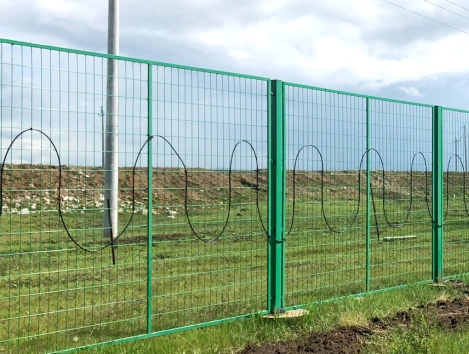
The site condition chooses the layer
Start with the places most likely to fail
Distance defeats response
A 10 km boundary cannot be searched on foot. Without position data, the guard arrives at the wrong place or gives up. The detection layer must report a location, not only a zone.
Wildlife and wind
Open ground brings animals, blowing debris and wind load on the fence. A system tuned for a quiet urban wall will alarm continuously here.
No power along the line
Power and network may exist only at the ends. Every powered node along the boundary is a cost and a failure point; passive fibre is often the practical choice.
Layer by layer
Layer-by-layer configuration
Long linear layer — locating fibre
Vibration fibre with a locating processor runs the full boundary. Position accuracy is quoted with distance: ±1 m within 10 km, widening to ±20 m at 40–60 km. That is enough to send a vehicle patrol to a gate or marker.
Open spans — laser barriers
Laser barriers cover gate approaches, culverts and open spans where the fibre route leaves the fence. Multi-beam columns make the crossing detectable at running speed.
Response layer — map and patrol
The control platform shows the alarm position on the site map and links to the nearest camera and gate. Patrol routes are defined by distance from the response post, not by equal zone length.
Systems used in this application
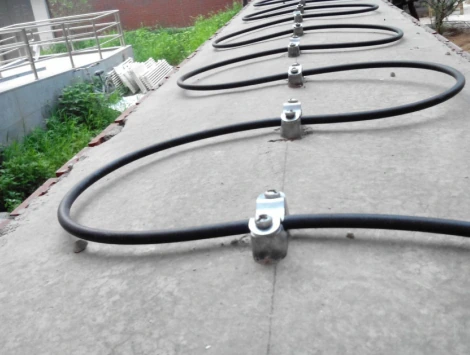
Vibration fibre
Covert detection · 1/2-zone collector · 4/8/16-channel chassis · locating unit
A sensing cable that hears climbing, cutting and digging along the whole run.
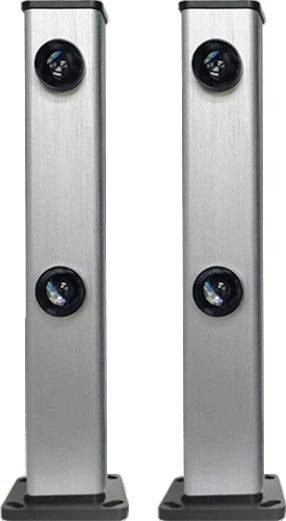
Laser barrier
Beam detection · 1–8 beam laser detectors
A narrow beam that holds its line for hundreds of metres.
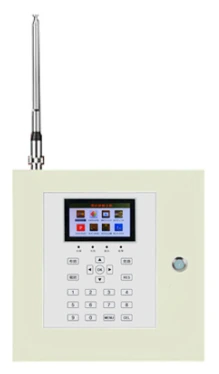
Electric fence alarm & control
Electric fence alarm · K7 / K9 / K10 hosts · touch terminal · management software
Arm, map and verify every electric fence zone from one interface.
Application questions
How accurate is fibre locating over 20 km?
The published accuracy is ±2 m at 10–20 km. That is enough to identify a marker post, but not to pinpoint a footprint. Pair it with cameras or patrol markers at known intervals.
Can the fibre share a duct with power or telecom cables?
Physically it can, but the sensing fibre should be mechanically isolated from cables that vibrate or heat. A fibre strapped to a power cable measures the cable, not the fence. Use a separate duct or a dedicated conduit along the fence.
What about animals crossing the line?
The processor filters by frequency and duration, and the fence itself can be fitted with a physical skirt or buried mesh to discourage animals. Do not solve an animal problem only by lowering sensitivity; that also hides a human crawl.
Plan this application
Send the site type, perimeter length and response model. We will propose a layered configuration.